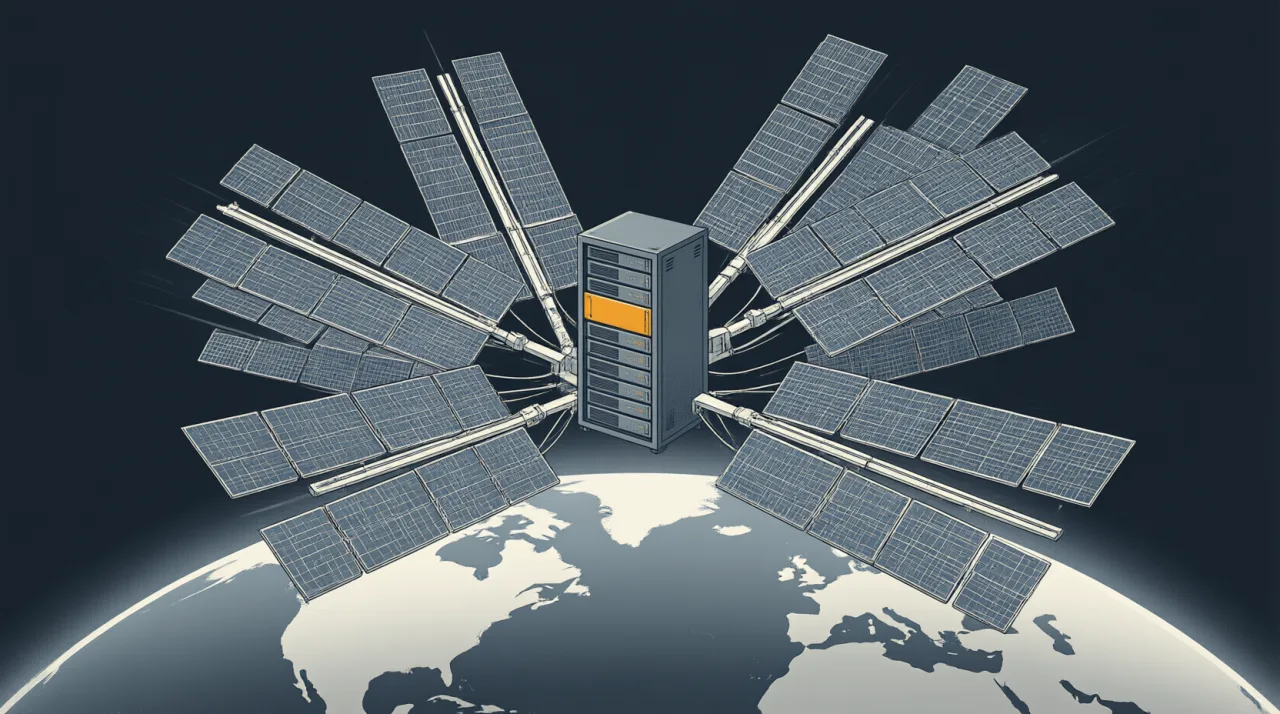
#1 Starcloud (formerly Lumen Orbit), white paper v1.03 said on 2024-09-01 · source
Energy costs in orbit can be around $0.002/kWh, about 10x cheaper than terrestrial data centers.
The claim that orbital data centers can offer energy at $0.002/kWh, 10x cheaper than terrestrial data centers, is partially contradicted. While Starcloud's white paper supports the $0.002/kWh figure, independent analyses show that space-based data centers currently have a 2.5x to 3x cost premium over terrestrial data centers. The key assumption of a very low launch cost ($30/kg) is not supported by current data, where launch costs are much higher. This makes the overall claim of 10x cheaper energy costs in orbit not fully supported.
Citations
- starcloudinc.github.io: “we will be able to offer an equivalent energy cost of ~$0.002/kWh. For comparison, the US, UK, and Japan typically achieve average wholesale electricity costs of $0.045/kWh6, $0.06/kWh7 and $0.17/kWh8, respectively. Orbital data centers can therefore offer energy 22 times lower cost than today’s energy prices.”
- www.bcg.com: “space-based data centers carry a 2.5x to 3x cost premium over terrestrial infrastructure today, with a 20-year TCO of approximately $660 million to $750 million per MW, compared with $230 million to $300 million per MW for terrestrial data centers. Future improvements will narrow the gap, but are unlikely to eliminate it.”
What would change this
- Independent verification of actual energy costs in orbit
- More recent launch cost data supporting the $30/kg assumption
Earlier versions (1)
- Partially contradicted v1 · qwen-max · 2026-09-22 15:48
The core of Starcloud's claim relies on an exceptionally low launch cost of $30/kg, which is contradicted by multiple independent sources. While the solar power generation cost and the TCO premium are supported, the overall claim of energy being 10x cheaper is not. The claim is partially contradicted due to the unrealistic launch cost assumption.
Evidence on this claim
- https://starcloudinc.github.io/wp.pdfcited in v2
we will be able to offer an equivalent energy cost of ~$0.002/kWh. For comparison, the US, UK, and Japan typically achieve average wholesale electricity costs of $0.045/kWh6, $0.06/kWh7 and $0.17/kWh8, respectively. Orbital data centers can therefore offer energy 22 times lower cost than today’s energy prices.
by WeirdTrue · 2026-09-23 · excerpt found in source
With a payload capacity of 100 tons to Low Earth Orbit (LEO) Sun-Synchronous Orbit (SSO), this translates to approximately $30 per kilogram. It has been suggested that costs could drop to as low as $10 per kilogram.
by WeirdTrue · 2026-09-23 · excerpt found in source
our analysis of historical and projected launch pricing data suggests that with a sustained learning rate, prices may fall to less than $200/kg by the mid-2030s . At that price point, the cost of launching and operating a space-based data center could become roughly comparable to the reported energy costs of an equivalent terrestrial data center on a per-kilowatt/year basis
by WeirdTrue · 2026-09-23 · excerpt found in source
At m_kW ~ 40 kg/kW, a terrestrial infrastructure benchmark of 10-40 k\$/kW allows only 250-1000 \$/kg for the combined launch and spacecraft-build cost before space-to-ground communications, operations, utilization, and lifetime terms are included.
by WeirdTrue · 2026-09-23 · excerpt found in source
space-based data centers carry a 2.5x to 3x cost premium over terrestrial infrastructure today, with a 20-year TCO of approximately $660 million to $750 million per MW, compared with $230 million to $300 million per MW for terrestrial data centers. Future improvements will narrow the gap, but are unlikely to eliminate it.
by WeirdTrue · 2026-09-23 · excerpt found in source
Radiators and solar arrays can consume 65 to 70 percent of total satellite mass, and space-grade photovoltaics run orders of magnitude more expensive than terrestrial equivalents.
by WeirdTrue · 2026-09-23 · excerpt found in source
It showed that the cost to launch and run a GPU in space for a year is at least an order of magnitude higher than the same feat in a terrestrial data center.
by WeirdTrue · 2026-09-23 · excerpt found in source
On January 30, 2026, SpaceX filed an application seeking authority to launch and operate a new NGSO satellite system of up to one million satellites to operate as the “SpaceX Orbital Data Center system” (System). The System will operate at altitudes ranging from 500 km to 2,000 km
by WeirdTrue · 2026-09-23 · excerpt found in source